|
|

|
|
S
oapy Smith considered himself a businessman and opened several saloon, gambling, and cigar establishments
in his life-time. Most of these dens served alcohol and games of chance. All were in operation to take in as much money as
possible using any means necessary, just short of outright robbery. Some of these establishments were well-known and reported
within the pages of newspapers, while other resorts are known only by way of references. Photographs show he often adorned
his saloons with US flags and patriotic bunting on the outsides. Only Jeff Smith 's Parlor has known photographs of the
interior that show patriotic embellishments on the inside walls, as well as the exterior.
The Tivoli Club
and
The Silver Club
|
|
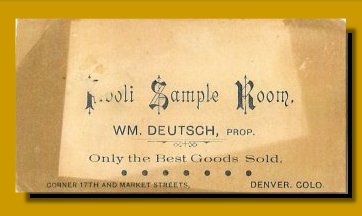
Later Tivoli Sample Room card (Geri Murphy Col.)
|
|
|
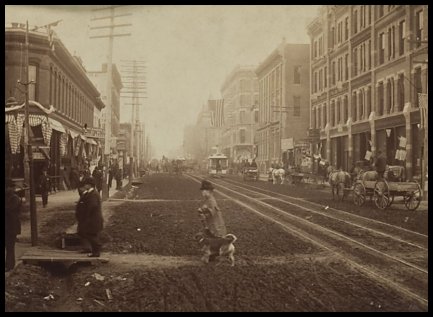
The Tivoli Club (left), circa 1890 (Jeff Smith Col.)
|
T
he Tivoli Club opened
its doors in 1888 with partner and well-known Denver crime boss, "Big Ed "Chase at 1337-1339 Seventeenth Street
on the south-east corner at Market Street in a two story building. The saloon was downstairs while gambling (faro, roulette
tables, and a poker room) could be found upstairs. Legend states that for legal purposes, Soapy hung a sign at the bottom
of the stairway that read, "Caveat Emptor."One would need to read Latin to know that it means, let the buyer
beware
.
In at least one court case, it is known that Soapy defended
the activities inside the Tivoli Club by comparing them to the cures of the Keely Institute. What Keely 's was to the alcohol
habit, the Tivoli was to the gambling habit.
You
see, there are gamblers and gamblers. Now, these crap game men only make tin-horn gamblers, for this reason: When a man runs
up against one of them he loses his money slowly, but surely. He wins a little occasionally, and becomes fascinated with the
game. Then he winds up by becoming a gambler himself. But when they ‘run up 'against me ‘it 's off with
them.'They 're just paralyzed. I take everything they 've got in short order, and they just throw up their hands
and swear they 'll never gamble again-and they don 't. I tell you, I 'm a reformer,
... Denver Evening Post
, March 18, 1898.
The Rocky
Mountain News
dubbed the Tivoli Club, "the slaughter pen "due to the violence that occurred there.
The Tivoli
appears briefly as the Silver Club in 1890. Perhaps a ploy to separate the two businesses and Soapy 's involvement with
the gambling end of the business. Soapy tried hard as the years passed to appear (on paper) not to be associated with the
clubs but few, including the newspapers, believed him and he continued to be listed as the owner. Amazingly, with all the
gunfights and brawls that took place within its walls, future owners kept the notorious name.
|
|
|
|
|
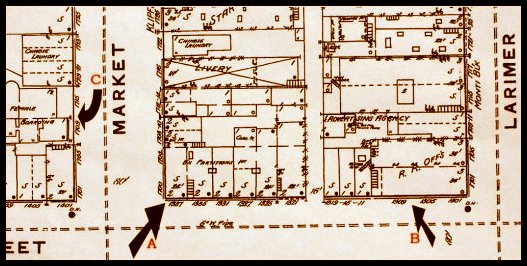
1890 Denver Sanborn map, 17th & Market streets
|
|
|
The Tivoli Club and Soapy's office
|
The following Sanborn insurance map for 1890 shows the location of the Tivoli Club (A) and all its escape routes.
The Chever Block (B) shows where Jeff had an upstairs office, as well as (later) the Midway Club. Interestingly enough, these
old Sanborn maps also showed the location of brothels, labeling them as "Female Boarding "(C).
|
|
|
|
|
|
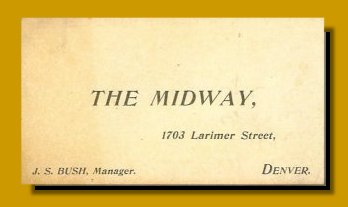
The Midway Club card (Geri Murphy Col.)
|
|
|
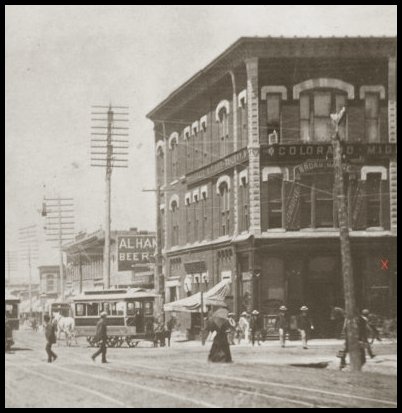
The Midway saloon (red "X") (Denver Lib. Col.)
|
Little is known
of the Midway saloon located inside the Chever Block at 1703 Larimer Street. A business card from the saloon was among the
other business artifacts in the Smith family collection.
COLFAX, COLORADO
|
|
|
|
The White Front
Little
is known of this gambling resort resort except that it was part of a mass exodus by the saloon and gaming fraternity in Denver
due to reforms against their businesses. Plans were made to make Colfax the "Monte Carlo of Colorado "and this idea
was welcomed by the city council at the start, but the little city fathers soon changed their minds.
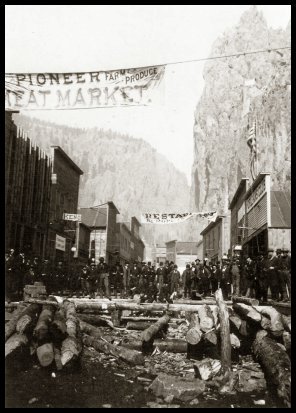
|
|
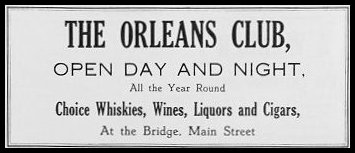
The Orleans Club, 1892 (Creede Hist. Soc.)
|
O
pened in February 1892 the Orleans Club was said to have stayed opened nearly 24-hours-a-day
for gambling and drinking. It was located on Main Street, also known as Creede Avenue. Like the Tivoli Club in Denver, the
Orleans Club had its share of violence associated with it. Several poems written at the time include the goings on inside
the infamous gaming den. The Orleans Club lasted a mere four months when the great Creede fire of June 5, 1892 destroyed the
building, along with most of the business district.
|
|
|
|
The Klondike
T
he Klondike saloon was located on the northeast corner of Broadway and McKinney Streets (later named 5th
Ave.). In late 1897 it is believed that Soapy owned an interest in the saloon and gambling hall with partners Ira
Coslett and a man named Ward. In December the saloon moved into a two story structure on Broadway and Holly Streets (later
named 6th Ave.) where a music hall was advertised with the business. It is believed that Frank Reid, one of the men who shot
Soapy during the Shootout on Juneau Wharf, worked for him as a bartender.
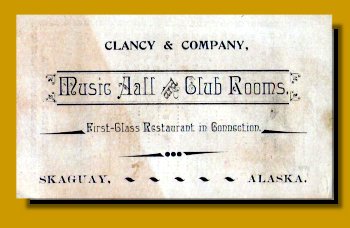
Clancy and Company
Music Hall and Clubrooms
|
|
Clancy and Co. business card (Jeff Smith Col.)
|
The next saloon interest
Soapy invested with was with Clancy 's Place operated by two brothers, John and Frank Clancy who added "and Company "to the business name, when Soapy joined the brothers. It was located at Runnals and Shoup Streets (later named 7th and State
Streets)
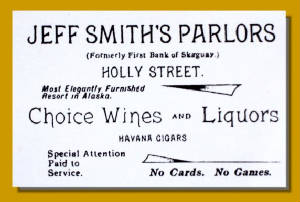
|
|
Ad as it appeared in the Skaguay News, 1898
|
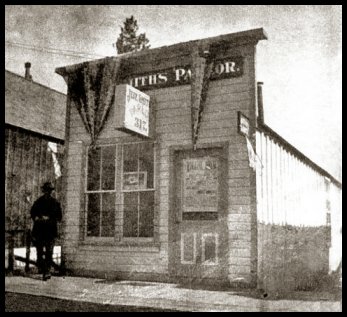
|
|
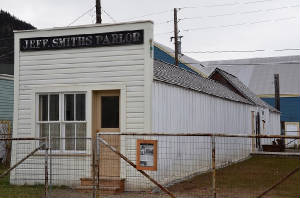
Jeff Smith's Parlor, 1898 (Cynthia Brackett Col.)
|
T
he most famous of
Soapy 's saloons is Jeff Smith 's Parlor. It was the only one opened strictly as a saloon, with no gambling allowed
inside, and advertising as much. It is also the only one still standing.
In the Spring of 1898 Soapy and
the Clancy 's split interest in the business building that previously held the First Bank of Skaguay, a false-fronted,
single-story wood building located at 317 Holly Street (Block 3, lot 12), just a few doors west of Broadway on the north side.
The Parlor, sometimes called "Jeff 's place,"was known as "the real city hall."The city had a local
government that met elsewhere, but many important decisions regarding how business would be conducted within the city were
actually made inside the small office of this little saloon.
City records are not clear as to who actually
owned the building, but Soapy controlled the business. Changes made to the bank building included moving the front entrance
from the middle of the front facade to the far right in order to accommodate the bar. Two widows were moved from each side
of the entrance to the left side. A large sign was hung just below the cornice that read, JEFF. SMITH 'S PARLOR.. There
is little doubt that Soapy ran the place his way. Note the periods after "JEFF."and "PARLOR."The first
is easy to explain, as Jeff
is short for Jefferson
, thus the period made "JEFF."and abbreviation.
The second period is a little harder to explain. Retired English Professor Art Petersen could not find a logical reason for
it. Personally, I believe it is also an abbreviation of sorts. Perhaps the sign, if published in its entirety, would read, "JEFFERSON SMITH 'S PARLORS."Note the "S "in Parlors
. Could the sign painter have run
out of room for that last letter? So why add an "S "to "PARLOR?"A nondescript cabin looking building
next-door to the saloon is believed to have been part of the business, whether as a store-room, a restaurant (as described
in one account), or a gaming den (as described in another account), or perhaps all three.
|
Inside the saloon
|
|
|
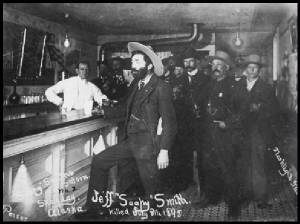
Soapy stands at his bar
|
(photo) Soapy
stands in the center at his bar with a cigar. Partner John Clancy leans into the photograph to Soapy 's right. Nate Pollack
tends bar, and back by the stove pipe is believed to be John Bowers. Two other unidentified men stand to the far right. This
photograph dates between March and July of 1898. "July 4, 1898 "appears at the bottom, but this date is not thought
to be exact. It is probable that someone added the date to sensationalize the photograph. Based on the flags behind the bartender,
someone in possession of the photograph might have also assumed that they were for the July 4th celebration. A close inspection
of the bunting reveals that it contains the U.S. and Cuban flags which signify Soapy 's wave of patriotism that accompanied
the outset of the Spanish American War, which in April 1898 was at fever pitch. The door to the office is open. A door leading
out the rear of the saloon is shut. The light bulbs are exposed. Electricity was expensive, and Soapy no doubt did not want
to hide the fact that he had electric lighting or diminish their illumination behind lamp shades.
A
fter Soapy was killed at the Shootout on Juneau Wharf, his
partner, John Clancy, took over the business. In quick order, his brother, Frank, opened up The Mirror Saloon. It was renamed
Clancy 's Cafe and advertised it as a "gentleman 's resort."In 1899, under new management, it became The
Sans Souci (bastard French for "Without a care "). In its advertisements, this restaurant included an oyster bar.
It appears the restaurant did not survive very long into the new century. Photographs indicate that the building itself changed
very little during this period.
In
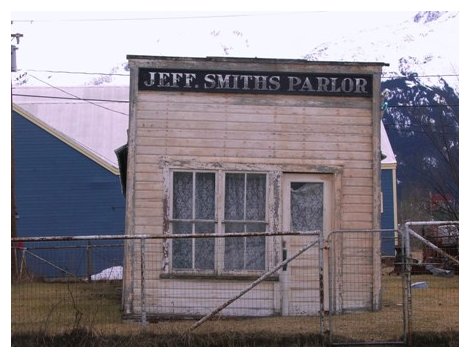
the late 1930s Jeff. Smith 's Parlor became a Soapy Smith museum. In 2007 the Parlor was purchased and donated to the Klondike
Gold Rush National Historic Park. In 2016 Jeff Smith 's Parlor opened to the general public as a display on Skagway tourism.
Most important is the fact that the Parlor building is saved from total destruction and that future generations will continue
to enjoy learning about Soapy Smith.
|
|
How the saloon looks pre-restoration
|
|
Restored 2016
|
|
|
|
Jeff. Smith's Parlor
|
| |
|
WOULD YOU LIKE TO KNOW MORE?
read
Alias Soapy Smith: The Life and Death of a Scoundrel
No images
or text may be used without prior written consent.
| | |
|